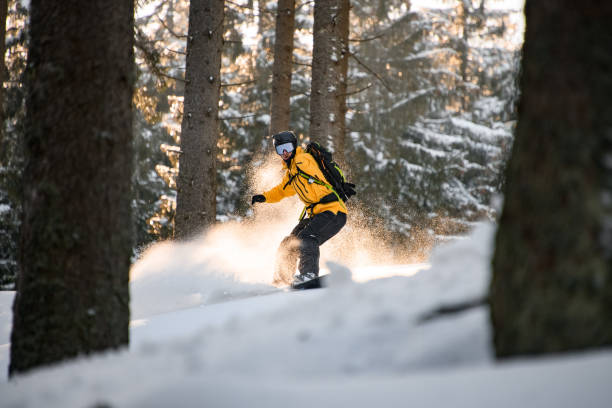

The first time you truly understand the meaning of “backcountry skiing” is often not on a grounds park, but on a mountain ridge where the wind sounds as crisp as a knife. When you stand before a natural, irregular powder slope, the world beneath your feet is as perfect as an oil painting—but you know that it could also, like a joke, throw you into an abyss in the next second.
The charm of backcountry skiing lies in this:
there are no patrolmen, no ski area boundaries, and no one to help you. It’s just you, your skis, your judgment of the terrain, and the unpredictable weather.
But what truly makes top off-piste skiers feel “out of reach” is often not the quality of the snow, nor the forest line, but rather— the end of the terrain .
You’re standing on this hilltop, wanting to reach that perfect slope on the other side, like a freshly baked cake, but a 100-meter cliff separates you. Conventional logic tells you:
cliff? Go around it.
Icefall? Avoid it.
Precipice and jagged rocks? Forget about it, find another route.
Okay, that logic is outdated.
On this planet, there lived a small group of madmen who refused to accept the map provided by gravity. They decided to “give skiers wings.” And so, Speedriding came into being.
This sport is so outrageous that first-time visitors often ask,
“Is this skiing or flying?”
The correct answer is:
it is both, but also neither.
From 2D to 3D: When Skiing No Longer Only Happens on the Ground
Most skiers envision skiing as a flat game. You glide, turn, jump, and float along the slope. Even with big air or cliff drops, it’s still a “drop from high to low,” and you still rely on snow to land.
But Speedriding rewrote the rules.
It transforms skiing from two-dimensional to three-dimensional.
You no longer draw lines on the snow, but in the air.
Speedriding doesn’t use ordinary paragliders, but rather a small-sized wing specifically designed for low-altitude flight— the Speed Wing .
Unlike paragliding, which aims for leisurely floating at high altitudes,
or wingsuit flying, which strives for insane horizontal speeds,
it has only one goal:
to get you off the ground quickly and back down just as fast, switching between modes at any moment.
It sounds like cheating, right?
But it’s not about “taking shortcuts,” but about allowing players in wild snow to break through the original terrain limitations.
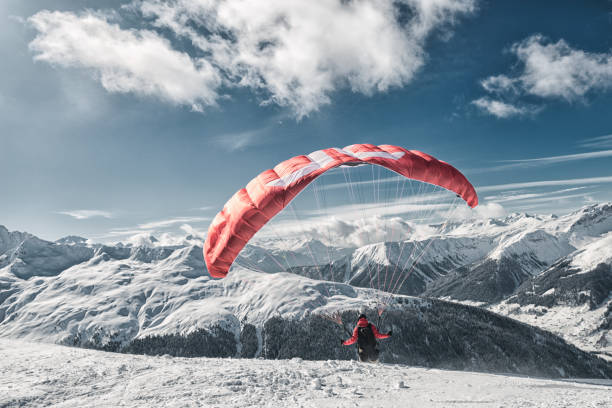
Glide → Takeoff → Glide again: This is a “hybrid” extreme sport.
If I had to explain speedriding in one sentence, it would be:
They glide on the snow and travel through the air.
On a regular powder slope, you can still ski like you’re skiing.
When you encounter cliffs, icefalls, or precipices, you can gently pull the brake lines, and the paraglider will instantly generate lift, lifting you off the ground.
After flying over the obstacle, you land back on the snow and continue skiing.
The whole process is like playing a 3D version of a snow mountain game, with all levels on the map unlocked.
Terrain that used to require detours can now be crossed directly.
Areas of loose rocks that were once treacherous can now be traversed in seconds.
Snow slopes that you could only admire from afar are now your private stage.
This is what makes Speedriding so fascinating:
it transforms the “finite” world of off-piste snow into “almost infinite”.
But don’t get me wrong: this is the next stage of skiing, not a shortcut.
Many people’s first reaction to Speedriding is:
“To be able to fly over a cliff with just a parachute, that’s so awesome!”
No, that’s not it.
Speedriding looks like skiing plus parachuting, but it’s actually:
skiing, flying, meteorology, wind field assessment, technical management, and psychological regulation
.
It requires skiers to step out of the familiar snow and into a completely new system:
the air.
On the snow, you’re used to relying on the edge to control your speed;
in the air, you have to rely on the wind.
This was a huge shock to the minds of pure skiers.
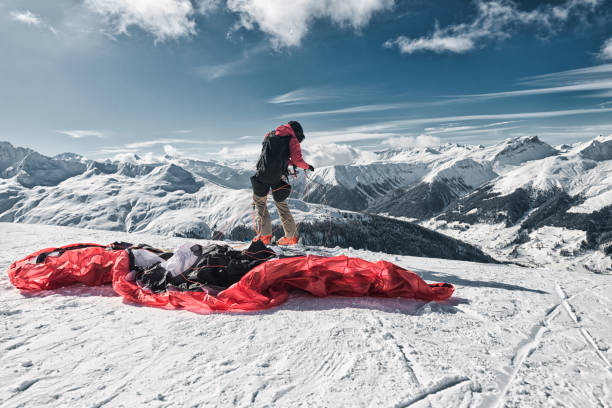
A lesson every skier must learn: Aerodynamics
In speedriding, the wind isn’t just background; it’s the main character.
Many skiers’ first impression of speedriding is:
“The wind is so powerful!”
To avoid surrendering your life to the wind, you must understand it. This includes:
① Meteorology
Rising airflow on the windward side of the ridge
The “rotor wind” on the leeward side.
Turbulence caused by wind shear
Venturi effect in the canyon
These are not “theoretical knowledge,” but knowledge about life and death.
A single misjudgment could lead to the umbrella collapsing or, worse, falling into a crevasse.
② Wing Handling
The parachute wings are not decorations on your back, but your steering wheel in three-dimensional space.
You need to learn
sharp turn
Floating control
Fine-tuning lift during high-speed, low-altitude flight
Determining the point of impact with the snow surface
There is no “autopilot” here.
You must understand the air to master it.
Speedriding brings not only freedom to skiing, but also a way to redefine the “limit”.
What are the limits of traditional off-piste skiing?
Snow conditions, slope, weather, treeline, rock face, cliff.
What are the limits of speedriding?
Wind, lift, space, speed, and flight strategy.
The two seem to be limits of different dimensions, but when you combine them, they superimpose in a wonderful way.
You suddenly possess:
Higher-dimensional route planning capabilities
Wider terrain access
Previously unattainable degrees of freedom on snow slopes
A “multi-segment” play style that switches between the air and the snow surface.
You begin to read mountains like a pilot, snow like a skier, and weather like a mountaineer.
In a sense, Speedriding is the “ultimate all-rounder” in the world of snow-capped mountains.
With a parachute pack on your back, you’re no longer just an ordinary skier, but practically a pilot.
I’d like to give a real example.
There are many speedriding enthusiasts in Europe who were originally top freeride riders.
When they started playing Speed Wing, it felt like suddenly upgrading from a 2D game level to a 3D sandbox mode:
“So you can fly over and land in the snow trough behind this ridge?”
“So you don’t need to go around this scree slope at all, you can just fly close to the ground?”
“So there are so many ‘hidden routes’ throughout the mountain?”
Once you’ve experienced that freedom, it’s hard to go back to the world of ordinary skiing.
You’ll feel like the mountains have been unlocked again.
The only price to pay is this:
you must learn
, you must respect the wind,
you must be more cautious than others,
and you must maintain a sense of awe for the air.
Because that wasn’t a ski resort; it was a real mountain.
There were no safety nets there.
In conclusion: When you look up at the sky, you’ve truly stepped into the next stage of skiing.
Speedriding is the illegitimate child of skiing and the sky.
It inherits the speed of skiing and the freedom of flight.
More importantly, it broke the rule that “terrain limits skiers.”
From then on, skiers, not terrain, determined the route.
If you feel that traditional backcountry skiing no longer satisfies you,
if you yearn to unlock the full potential of the mountain,
if you want to ski on routes that others wouldn’t even dare to look at,
The answer is probably not to buy wider powder skis,
nor to get stiffer boots,
but rather—
Learn to think like a bird.
Try to understand the wind.
Try to feel lift.
Try to learn extreme sports in the sky .
Because that’s where your skiing career truly begins.
The moment you put on your parachute, you’re no longer just a skier.
You’re a pilot, an adventurer.
You’re entering a new dimension, a truly free world.
Safety note: This article is for general information only. It is not medical, training, emergency, survival, or professional safety advice. Conditions, equipment needs, and personal health factors vary, so check current local guidance and consult qualified professionals before acting.


