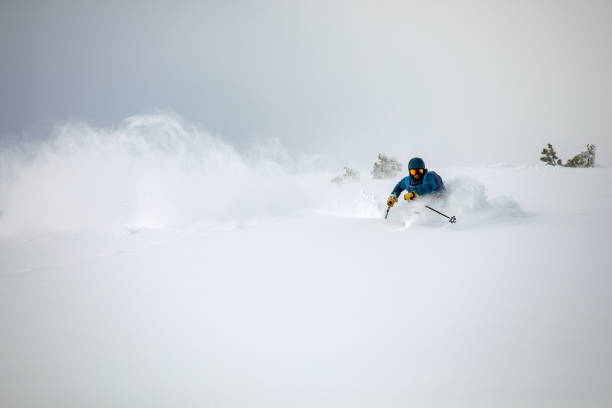

Those who spend enough time in the snow mountains will eventually fall into the same trap: you will become less and less concerned about the ski slopes, snow grooming, and race routes, and start to become obsessed with one thing— powder .
That urge to spring out of bed at 5 a.m. and queue for the first cable car before dawn; that moment of rushing into deep snow the day after a blizzard, with powder reaching your knees or even thighs; and that “epiphany” when you look back and see that perfect wave of snow, the billowing snow mist, and feel yourself swallowed up like entering a white room.
These things are addictive, and they will push you further and further away.
The question is:
Why are modern powder snowboards becoming more and more like surfboards?
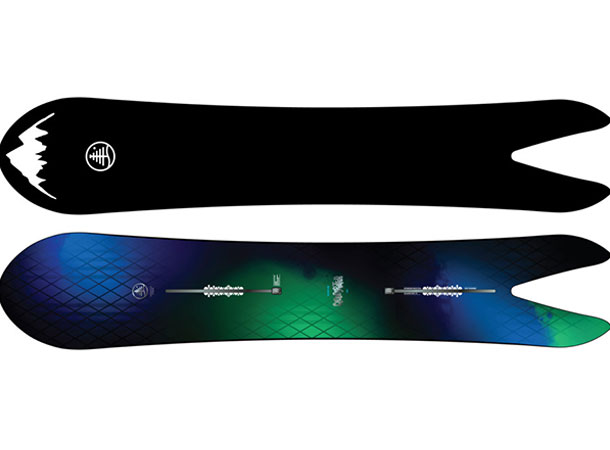
Why is it that the nose of the new board you buy is getting bigger and bigger, the stance is getting further back, and the tail is even split into a “V” shape—the legendary Swallowtail ?
If you’re willing to dig deeper, you’ll find that
almost all powder snow technology, powder snowboard design, and aesthetic styles today are secretly returning to one source— water extreme sports , especially surfing.
1. Deep snow = low-density water: Why is snowboard design regressing?
There’s an old saying in the skiing community:
“Snowboarding is surfing frozen water.”
It sounds like something a pretentious person would say, but it’s actually based on physics.
Deep snow is neither ice nor a solid.
It is a “solid version” of water with lower density and less resistance.
You’re sliding on fluid, not on the ground.
Once you realize this, you’ll suddenly understand many designs:
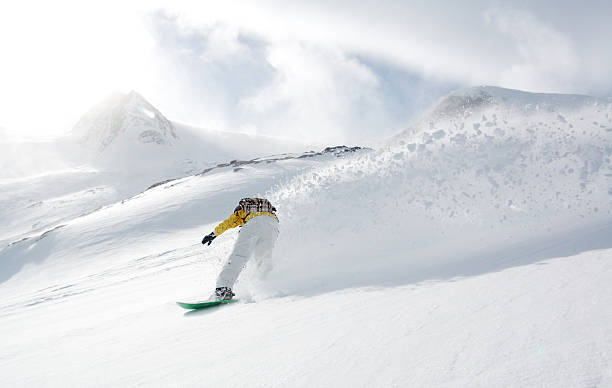
1. The Big Nose – The Buoyancy Logic of Longboard Surfing
In powder snow, speed isn’t the most important thing; it’s floating.
A large nose provides greater buoyancy, allowing you to float on the snow instead of sinking into it.
This is typical surfboard logic:
the nose of a longboard is made larger in order to keep it afloat in weak waves.
2. Setback Position – Imitating a surfer standing at the tail of the board.
Surfers always stand near the tail and use the tail to lift the nose of the board, getting it into the correct angle.
The same applies in deep snow:
a rearward stance allows you to naturally lift your head, doesn’t strain your legs, and avoids excessive leaning back until your calves cramp.
3. Swallowtail – A tail design directly copied from Surfboard.
If we had to say which design is a true “regression,” it would definitely be the swallowtail.
In surfing, the Swallowtail serves two purposes:
Reduced tail buoyancy (sink tail) → helps you steer more nimbly.
Maintaining a stable sense of direction at high speeds → Keeping the line in large waves
In powder snow, the physics are exactly the same:
The swallowtail allows the tail to sink naturally.
The board head naturally rises.
You can “cut through the water” like surfing, and enter floating mode faster.
Steering requires only a gentle press of the ankle, as easy as drawing a calligraphy brush.
Why do many professional powder skiers say that Swallowtail is like “using cheat codes”?
Because it makes the snow lighter, making it feel more like drawing lines rather than pushing snow.
Second, stop using the “grooming mindset” when skiing powder: Skiing in deep snow is 3D, not 2D.
The most frequently asked question by people new to powder snow is:
“Why do I keep flipping over in powder snow?”
“Why do I keep plunging into the snow even when I’m going fast enough?”
All I can say is… because you’re still using the logic of hard ski slopes.
On hard snow runs, you ski in two dimensions: left and right.
In powder snow, you glide in three dimensions: up and down + left and right.
Instead of using the steel edge to cut the ice surface, you use the entire “surface” of the plate to squeeze the fluid.
The same applies to surfing.
When surfing, you don’t cut the wave with the steel edge.
You rely on the lift created between the bottom of the board and the water.
The same applies to powder snow:
Speed = Your driving force forward
Bottom angle = How you control buoyancy
Porpoising, also known as dolphin jumping, involves using the body to allow the skis to “breathe” in the snow.
That’s why people who ski on powder snow so smoothly look like they’re doing a little dance. They’re not dancing; they’re adjusting their buoyancy.
III. Why do powder snow experts all surf? — Because surfing is the “original tutorial” for powder snow.
If you observe carefully, you will discover an interesting phenomenon:
The world’s best powder skiers spend their summers in the sea.
for example:
Craig Kelly was an avid surfer back in the day.
Gentemstick’s founder, Taro Tamai, built the entire brand on the concept of surfing.
Local skaters in Niseko, Japan, spend almost all their summer surfing.
American skateboarders flock to California and Hawaii in the summer to “read the sea.”
Why?
Because surfing can teach you things that powder snow can’t:
1. How to “read the terrain”
The waves are always changing, and the powder snow is never the same.
Surfers are born with the ability to judge:
Where there is power
Where can I speed it up?
Where will it fall?
Where should I switch back?
These skills are practically invincible in powder snow.
2. How to utilize fluids, rather than fight them.
In powder snow, the less force you use, the better; the smoother the ride, the faster you go.
The same applies to surfing: the harder you push, the slower you go.
3. How to maintain equilibrium in an unstable three-dimensional space?
Surfboards are harder to control than snowboards, but once you learn how to ride the waves, you’ll find it incredibly easy on the snow.
Fourth, “powder snow aesthetics” is making a complete comeback to Surf.
You may not have noticed, but an aesthetic revolution is taking place in the powder snowboard world in recent years:
The board is becoming more and more like a surfboard.
Standing posture is becoming more and more like surfing.
Sliding is becoming increasingly fluid
The video style is also increasingly resembling Surf movies.
From Gentemstick to Korua, from Burton Family Tree to Jones Surf Series, every brand tells the same story:
“Back to the starting point, back to the fluid.”
Every line you draw on the snow is a metaphor for ocean waves.
V. Conclusion: The ultimate truth about powder skiing can be summed up in one sentence.
To ski well on powder, you must think like water.
This is why everyone who truly understands powder snow also understands surfing.
Surfing is not just a “summer activity.”
It’s your ski teacher, your language source, your movement template, and your sensory matrix.
So if you really want to get better next ski season, it’s not about buying wider skis or watching more instructional videos.
Instead:
Take off your ski suit and jump into the sea.
Experience the raw, primal power of the fluid.
It’s the beginning and the end of skiing.
All your epiphanies from the powder snow are hidden in the waves.
Safety note: This article is for general information only. It is not medical, training, emergency, survival, or professional safety advice. Conditions, equipment needs, and personal health factors vary, so check current local guidance and consult qualified professionals before acting.


