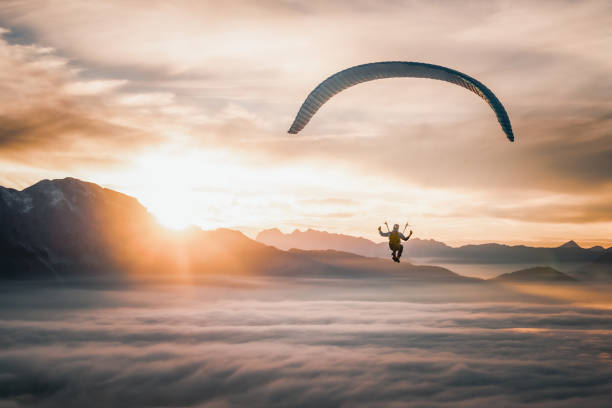

For those of us who are fascinated by extreme sky sports, gravity is a strange phenomenon—
it’s both your most loyal companion and your “rival” that sends your heart racing every time you exit the plane.
Whether it’s the moment you jump out of a plane at 14,000 feet or the moment you fly close to the ground in a wingsuit along a mountain ridge, what we’re pursuing is the same essence:
complete, pure, and unrestricted freedom.
In the tens of seconds of freefall, you are no longer bound by the plane; your body is like an airplane without a fuselage, diving, turning, tracking, and flying horizontally in three-dimensional space.
However, this freedom is never “quiet”—the
wind is almost roaring, the vibrations from the speed open all your senses, and your brain processes a massive amount of information with high alert.
However, if you want to retain the “soul of flight” but wish to turn the noise to mute, slow down the speed, and experience a more introspective, more meditative weightlessness…
then you should turn from the sky to the ocean.
Within the realm of extreme sports, water-based extreme sports include a unique category—freediving.
Many top skydivers, wingsuit flyers, and air sports instructors refer to it as:
“flying in inner space.”
It shares striking similarities with skydiving, yet unfolds at a completely opposite pace.
It’s still 3D freedom, but the medium is different, so the body language is completely different.
Skydiving is a branch of aerodynamics;
freediving is a branch of fluid mechanics.
The moment you cross the sea, it’s like entering a world governed by another set of physical laws:
the buoyancy of the water gradually counteracts gravity, and your body no longer “falls” but floats.
Just like in the air, you can move in any direction—ascend, descend, flip, glide.
But your movements will be completely different:
In the air :
You need to be quick and decisive to counter the wind speed approaching 200 km/h.
Underwater :
You must slow down and make the movement a streamlined stretch.
If wingsuit flying is like tearing through the air and cleaving through the waves, then freediving is like:
a slow-motion wingsuit flight in liquid.
You are not fighting against the medium, but being embraced and enveloped by it.
That floating sensation of being supported by water will make you rediscover your body’s balance, posture, and sense of space.
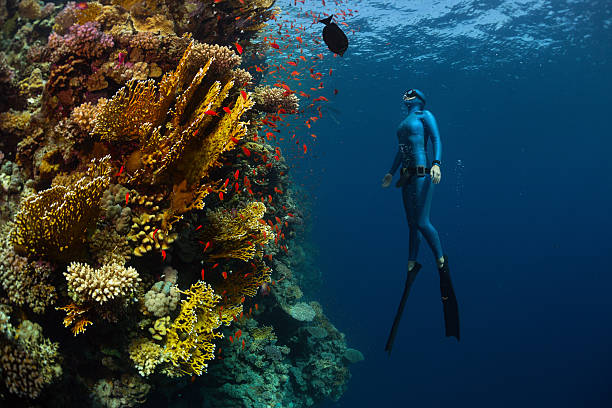
Adrenaline vs. Diving reflex in mammals:
Two extremes, yet they can complement each other.
Skydiving operates on an “excitement logic,” pushing your body into a primal survival program:
increased heart rate, accelerated breathing, and heightened concentration.
Freediving is exactly the opposite.
Underwater, you must “switch modes” in your body:
your heart rate decreases, your blood vessels constrict, and your metabolism slows down.
This is an ancient instinct possessed by all mammals—the “Mammalian Dive Reflex.”
For athletes accustomed to high-pressure, high-stimulation aerial activities, freediving is an amazing form of cross-training:
1. Extremely enhanced emotional control ability
In the depths of the sea, there is no sound of wind, no speed, no reference points.
Only you, the sound of your blood flowing, and your own breath.
This environment forces you
to remain calm in a closed and stressful environment.
This composure is precisely the key ability to handle skydiving emergencies (such as partial parachute deployment, double opening, and delayed parachute deployment).
Many experienced skydiving instructors say:
“People who are good at freediving are significantly more stable in handling emergencies.”
2. Breathing Management: A Hidden Skill Overlooked by Aerial Athletes
The most important thing in freediving is not holding your breath, but breathing efficiency.
Diaphragmatic breathing allows your body to utilize oxygen more efficiently and restores heart rate and focus in a short time.
This is for:
High-altitude skydiving
Long-duration flight missions
High-intensity repeated disconnection
Wingsuit
provides unexpected help with wide-ranging tracking …
You’ll find yourself less tense in the air and better able to maintain a steady rhythm.
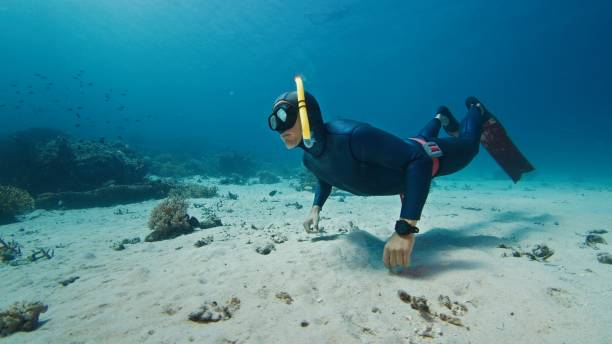
From 10,000 meters in the air to 100 meters deep in the ocean:
These two extremes are actually part of the same “free system”.
We always thought that the sky and the ocean were completely opposite worlds:
one pushes you away, the other envelops you;
one roars, the other is silent.
But they all give extreme athletes the same thing:
the freedom to leave the ground.
Skydiving gives you speed and explosiveness;
freediving gives you tranquility and introspection.
The two worlds are like two sides of a coin: one is fiery, the other is calm.
If you only experience the sky, you’ve only experienced half of extreme sports.
Conclusion: Change your fins and experience a different kind of flight.
If you’ve already experienced the exhilarating speed of a bird in the sky;
if you’re already used to the “chaotic freedom” of being surrounded by wind noise;
So, why not try a different way of “flying”?
Put on long flippers, take a deep breath, and slowly sink underwater.
You will find:
There was no wind,
no deafening air currents,
and no external interference.
The only sounds are your heartbeat, the gentle popping of bubbles,
and the trail you leave in the water.
This is another kind of flight—
a kind of “liquid flight” with no gravity, no noise, and only tranquility.
That place is another blue frontier for the brave.
Safety note: This article is for general information only. It is not medical, training, emergency, survival, or professional safety advice. Conditions, equipment needs, and personal health factors vary, so check current local guidance and consult qualified professionals before acting.